Posts

DISASTER PLANNING: Mold and Water Salvage

Image
Growth Cycle of Mold Last week I attended a workshop in Springfield, Illinois at the Abraham Lincoln Presidential Library to learn about salvaging mold and water damaged library materials. It was hosted by Jennifer Hain Teper, Preservation Librarian and Head of Preservation Services at the University of Illinois at Urbana-Champaign and Bonnie Parr, Historical Documents Conservator at the Abraham Lincoln Presidential Library and Museum. The workshop included an overview of mold and library materials including: sources of mold, a brief introduction to health risks when dealing with mold, and options for remediation/removal. I did not know much about mold going into this workshop, so I was interested to learn some basic facts. For example, mold grows best at high temperatures and high humidity, which is why cold storage is best for archival materials. I also learned too new terms. Example of foxing, taken from The Private Library Foxing and efflorescence are two types of...

Celebrating 50 Years of Science: Fermilab

Image
Last Thursday I traveled to Batavia, Illinois for a tour of Fermi Laboratory and its archives, hosted by the Chicago Area Archivists and Fermilab archivist, Valerie Higgins. If you are unfamiliar with Fermilab here is a brief summary from their website : “As the United States' premier particle physics laboratory, we do science that matters. We work on the world's most advanced particle accelerators and dig down to the smallest building blocks of matter. We also probe the farthest reaches of the universe, seeking out the nature of dark matter and dark energy....Fermilab's 6,800-acre site is…managed by the Fermi Research Alliance LLC for the U.S. Department of Energy Office of Science.” I only had a general understanding of what Fermilab does before this trip, so I was excited to learn more. We traveled by bus through the campus to get to the archives. On the way, I learned the first director of Fermilab, Robert Wilson, was a skilled sculpture and architecture des...

Gateway to the West: #OMAMAC

Image
Spring is in the air and it’s the time of year for archivists across the Midwest to commiserate and share innovations and stories from their institutions. The Midwest Archives Conference occurred in Omaha, Nebraska last week, and I was fortunate enough to attend. Having never been to Omaha I was not sure what to expect of the city, but it is a lovely town with a rich history. Chief Standing Bear One of these rich histories is the impact of Chief Standing Bear of the Ponca tribe and the landmark court ruling in his favor. During the opening session of the conference journalist and historian Joe Starita and Nebraska Educational Television producer Christine Lesiak presented Standing Bear’s story. From the MAC program: “…Ponca chief Standing Bear, who, in 1877, was forcibly removed along with his tribe from his Nebraska homeland and marched to what was then known as Indian Territory (now Oklahoma). In an attempt to honor his son’s dying wish to be returned to their tradi...

This Week in History: Part Six

Image
Part six of This Week in History will be diving into Scribner’s Monthly: An Illustrated Magazine for the People , specifically the March edition from 1877. Scribner’s Monthly was a pictorial publication focusing on bringing art, science, and literature to the American people. Unfortunately, this publication was short-lived, only lasting from 1870-1881. Scribner’s Monthly was renamed to The Century Magazine following the sale of the company. Founder Charles Scribner came back and created Scribner’s Magazine in 1887 to compete with the highly successful Harper’s Weekly (which is discussed in Part Four of this series). Interior of New York Aquarium Fortunately, the March volume of Scribner’s Monthly is full of interesting articles, poetry, literature installments, advice, and a few other oddities. The headliner for March was the New York Aquarium, which opened December 10, 1876. The article has no author but the illustrations were provided by a local artist who documented...

Better Late than Never

Image
Hi everyone! I'm getting this blog in on the last day of the month, hence the title. USF is halfway through the semester (Spring Break is next week) and it seems people are ready for vacations. Student nurses coming out of St. Joseph College of Nursing ca. 1980s This will be a quick one because February has been a very quiet month in the archives. I am editing metadata for the soon to be published St. Joseph College of Nursing digital collection, which I think will add a great deal to the USF community. And that's about it for February in terms of archive projects. My other library duties are taking more time and consideration, so that's what I've been focusing on. Hopefully March will bring lots of donations and interesting stories! See you then.

Keep Moving Forward - 2017

Image
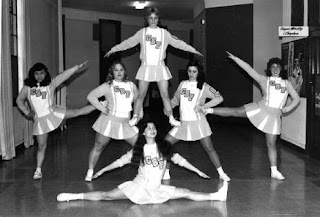
Entering my third year as Archivist at the University of St. Francis, I have new responsibilities in the library and goals for the archives. A Quick Recap College of St. Francis cheerleaders practicing in hallway ca. 1980-1989 At the beginning of last year my student worker, Adjo Tameklo, and history intern, Madison Bowie, worked together to add metadata for over 500 new images for the digital collection, Sharing Our Past, A Visual History . Many of the pictures depict USF athletics from the 1970s-1980s, which had been a gap in the collection. I was also able to catalog 400 books from the Barbara A. Cooke Musical Theater Collection . Mostly autobiographies, biographies, and historical reference books the collection is available to search in the Brown Library catalog. During the summer I became the Library Archives & Catalog Manager for the Brown Library. Along with managing the archives, I am now responsible for overseeing the cataloging and classification of mate...

AMERICA AT WAR: USF During WWII

Image
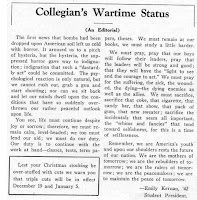
Excerpt from The Interlude December 12, 1941 Today marks the 75 th anniversary of the attacks on Pearl Harbor in 1941. This event propelled the United States’ military involvement in WWII. Interested to see how the attack affected the population at the College of St. Francis, I went through three of the archive’s collections ( the Interlude , Ephemera and Newspaper Clippings , and Sharing OurPast: A Visual History ) to find out. My first step was to check the student newspaper assuming there must have been something written immediately after the attack. To my surprise, I only found one small editorial written by student president, Emily Kernan. Speaking of the sudden shock, she wrote: “The psychological reaction is only natural, but we cannot rush out, grab a gun and start shooting; nor can we sit back and let out minds dwell upon the condition that have so suddenly overthrown our rather peaceful outlook upon life” (v. 14, no. 4, pg.1). Kernan stated CSF girls should contin...

This Week In History: Part Five

Image
(L to R) Bill Clinton, George H.W. Bush, Ross Perot Election Day is tomorrow , so I looked back in the student newspapers to see what USF students had to say about their elections. I found a very apt article from staff writer Paul Popek in volume 17, number 3 edition from the 1992 Encounter about the “mudsling tactics” which occur during campaigns.  For reference, there were three major candidates in 1992: Incumbent Republican President George H. W. Bush; Democratic Arkansas Governor Bill Clinton, and independent Texas businessman Ross Perot. The 2016 election is one of the most divisive in our nation’s history. The article touches on how negativity and "dirty politics" has become expected during elections and the issues take a backseat to name-calling. Please take the time to read the entire article, and don’t forget to VOTE ! Volume 17, Number 3 of Encounter, November 6, 1992

Chicago Open Archives 2016

Image
Research room in the Chicago History Museum October is American Archives Month and in celebration I attended Chicago Open Archives: Yours to Explore last week. Over thirty local archives, research centers, and cultural institutions in the Chicago area offered special events open to members of the public. I visited three archives, each with different missions and goals for their collections. First up, the Chicago History Museum . “The Chicago History Museum is a research center and exhibition space focused on collecting and telling Chicago's stories. In addition to exhibitions on Chicago’s history, the Chicago History Museum houses a Research Center which serves the research collections of the museum—archives and manuscripts, prints and photographs, published material, and architectural drawings.” With such vast holdings the archivists focused on their sports-related collections. The two-hour tour began in the museum with the typical cases the public can easily view. T...

Thank You, Alumni!

Image
This past weekend was homecoming at USF and I hosted a “USF History in Pictures.” Over the two hours, there were alumni from the 1991 nursing class, a couple 1992 business majors, and about 10 women from the 1966 class. They were celebrating their 50 th reunion! They reminisced about dorm living in Tower Hall, which consisted of 10pm curfews and 10 person rooms during their freshmen year. Still an all-girls school in 1966, they needed permission from their parents to go on dates with students from Lewis University. They also pointed out that the Uno Lounge where my display was used to be the mail room and a security guard was stationed there at night. Thank you to everyone who came out on homecoming weekend!

The Library at Fifty

Image
Conceptual drawing of CSF Library - 1965 With the construction of the new USF science building underway, I think it’s a good opportunity to look back at another building on campus. Specifically, the Library , home to the USF Archives. Coincidentally, construction of the two buildings fall fifty years apart.   Plans for a new and modern library began several years before any dirt was moved. The previous CSF library was in the Motherhouse, the first building on campus. The collection grew steadily over the 1930s-1960s, with a total of 70,000 volumes by 1964. The amount of undergraduate students increased over this period to around 1,100 students, which gave a compelling reason to build a standalone library building. Library during construction - 1966 Another reason to move forward with construction was due to the new Higher Education Facilities Act of 1963. It states:  "To authorize assistance to public and other nonprofit institutions of higher education...

This Week in History: Part Four

Image
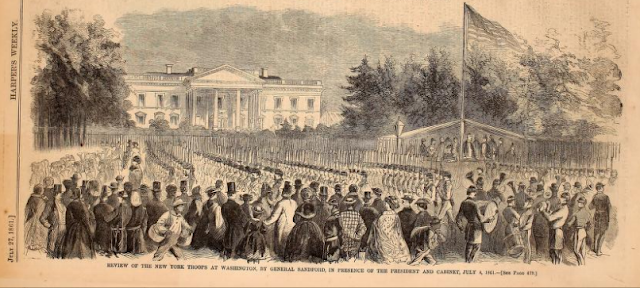
The latest installment of This Week in History takes us back to the American Civil War, specifically July 27, 1861. Harper’s Weekly, A Journal of Civilization was an American political magazine which was the most widely read publications of the 19 th century. Famous for their illustrations, Harper’s Weekly featured foreign and domestic news, works of fiction, and political essays. The USF Archives holds volumes five, six, and seven (1861-1863), but today I’ll be focusing on volume 5, issue 239. It was the beginning of the war, with the Battle of Bull Run – the first major land battle of the Civil War – fought the previous week on July 21 st . However, details of battles usually came out a couple weeks later. The editors of Harper’s fully supported President Lincoln and the Union once the war began, but because of their wide readership in the southern states they took a moderate stance on slavery. Readers of issue 239 were presented with news and illustrations from earl...

Musical Theater Collection - UPDATE

Image
We are halfway through 2016, so I want to do a quick update for one of the projects I discussed in the first post of this year ( go check it out if you haven’t read it !). Pictured: (left) Enchanted Evenings ; (right) Strippers, Showgirls, and Sharks ; (center) Broadway Musicals Beginning in March, I started to catalog the large number of biographies in the Barbara A. Cooke Musical Theater Collection. It was decided these books are best served as reference materials, which means they do not circulate. You might ask why, since this is a library and shouldn’t all books circulate? Normally, yes. However, the books add context to the songs, lyricists, composers, and shows the archived sheet music emphasizes, so I think they are more useful as reference books. Some of the influential people in the musical theater and motion picture world includes: Fred Astaire, Bing Crosby, Andrew Lloyd Webber, Stephen Sondheim and many more. Now they all have a place in the reference collect...

Time Spent in Milwaukee

Image
"Campbell's Soup Cans" by Andy Warhol One of the reasons I enjoy working for USF are the professional development opportunities. At the end of April I attended the Midwest Archives Conference (MAC) in Milwaukee, Wisconsin to learn about developing trends in the archival profession. If you’ve never attended a professional conference before, it is usually made up of concurrent sessions on various topics, vendor fairs, tours, and student poster presentations. I attended a behind-the-scenes tour of the Milwaukee Art Museum conservation lab before the conference sessions officially started. Unfortunately, I wasn’t allowed to take any pictures of the lab, but I did see a couple of Andy Warhol’s “Campbell’s Soup Cans.” At this year’s MAC, I attended the following sessions: From Theory to Action: A Pragmatic Approach to Digital Preservation Strategies and Tools (A Digital POWRR Workshop) Where Do We Store the Action Figures? Archives and the Growth of Popular...

Rediscovering Chicago's Film History

Image
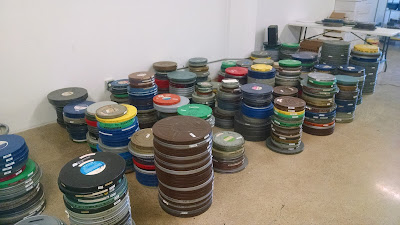
Last year I became the LIBRAS Archives Special Interest Group Chairperson; part of my job is to put events together which interest archivists and librarians within the LIBRAS community. The most recent event was a visit and tour of the Chicago Film Archives . Their website states: “The Chicago Film Archives is a non-profit 501(c) (3) institution established in late 2003 in order to preserve and catalogue over five thousand 16mm films donated by the Chicago Public Library.” Extra copies of films donated by the Chicago Public Library During the visit, we discussed how the film industry in Chicago boomed during the early 20 th century with actors including Charlie Chaplin getting their first start at Essanay Studios. Chicago was the film industry hub until the production companies moved to Hollywood.  The films at CFA cover the “dark ages” of Chicago and Midwest filmmaking. As a regional archive their collections relate to Midwest history, amateur filmmakers, and home...

This Week in History: Part Three

Image
Nature Magazine cover, March 1924 With spring fast approaching, it was a good opportunity to highlight one of USF’s rare book journals . Nature Magazine , which focused on the great outdoors, began publication in 1923 by the American Nature Association’s president, Charles Pack, and his son Arthur. They heralded themselves as, “…the answer to a long-felt want—a monthly magazine where the child and the grown-up alike may revel in pictures and stories of birds, beasts, fish, tress, plants and other living, breathing evidence of the Creator’s handiwork” (1). This sentiment made its way into each issue of the magazine, until its run ended in 1959. Articles typically focused on plant development, animal evolution and biology, travel excursions from members of the American Nature Association, and advertisements for campgrounds, outdoor wear, and national parks. Celebrities were featured occasionally, as well; for example, Florenz Ziegfeld – the American Broadway producer of the Zieg...

Snapshots of USF History - Updated!

Image
CSF Francisline cheerleaders in formation Over the past month my student worker, Jojo, and intern, Madison, have been busy, busy, busy! I tasked them with creating original metadata (information about information) for over 600 images, which depict events, people, and places from the University’s past. These images were added to the Sharing Our Past, A Visual History online collection. This project was achieved through a number of steps; the first included digitizing the physical photographs. This was completed at the beginning of 2015. Over December 2015 and January 2016, I looked over all the images to see which ones would be selected for the online collection. This is known as “appraisal” and done at least twice to determine which images should be included based on their historical significance to the institution. Reasons images might not be included in the collection are: Redundant/duplicate material Photographs which are blurry and/or of poor quality Material tha...

New Year, New Goals, New Dreams - 2016

Image
After my first year of being the University of St. Francis archivist, I hope to make 2016 as productive as last year. A Brief Recap Last year we created 18 individual collections relating to the University’s rich history, participated in Chicago Open Archives and showcased the Barbara A. Cooke Musical Theater Collection , implemented our records management system ArchivesSpace, and continued to fill requests from faculty, students, alumni, and the public. There are also a few new forms, making contact with the Archives easier. The Appointment Request Form can set up a time to meet with me individually or for a class session. I also created forms for our faculty and student groups to transfer  valuable  historical  records for permanent storage to the Archives. New Goals Over the next few months, my focus will be cataloging the 1,000+ books of the Barbara A. Cooke Musical Theater Collection. We will start with biographies, which focus on influential...